agentic-ai-llm
11 command-line packages · 10 measurement apps · 20 products
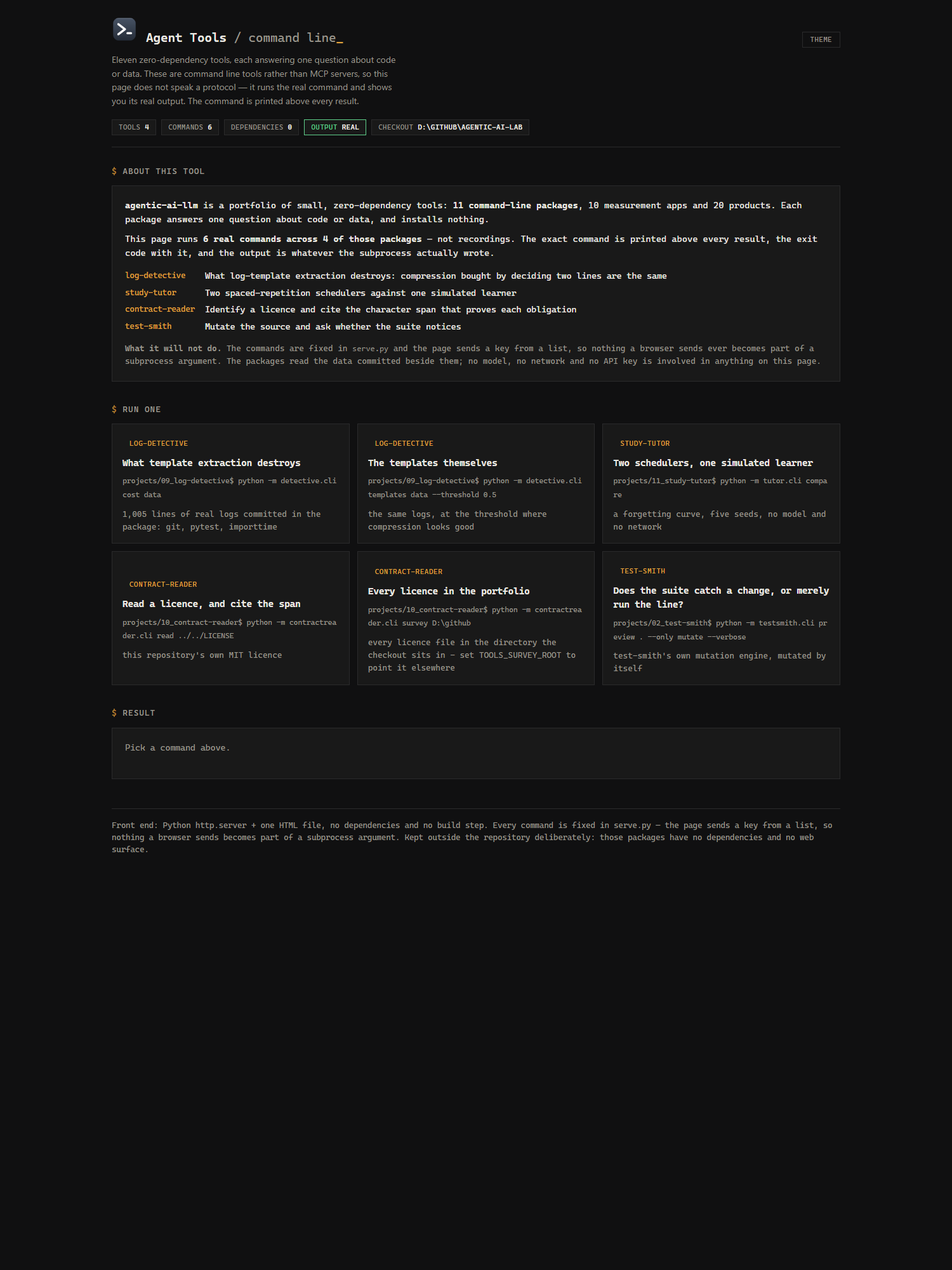
A portfolio of small tools that each answer one question about code or data, ten apps that each measure one thing about coder models, and twenty multi-agent operator consoles. Every projects/ package installs with zero dependencies.
Interface
Real measurements
How much wrong code does a three-assert benchmark accept? Break each reference solution in one place, run the problem's own tests, and search every survivor for an input on which it and the original disagree. A survivor with such a witness is a program the benchmark marked correct and is not.
| Measurement | MBPP (full) | MBPP (hand-verified) |
|---|---|---|
| Problems whose reference passes its own tests | 971 | 413 |
| Single-point mutants run | 4,055 | 1,553 |
| Mutants that still passed all three asserts | 731 (18.0%) | 257 (16.5%) |
| Of those, provably different programs | 362 (49.5% of survivors) | 121 (47.1% of survivors) |
| Problems accepting at least one broken version | 326 (33.6%) | 117 (28.3%) |
| Killed by a crash rather than a failed assert | 14.2% | 13.5% |
Reproduced from scratch for this page: the counts match the summary committed in the repository exactly, on both splits. The whole measurement loads no model and runs in about 36 minutes on one CPU.
a second app, with a labelled split and no model at all
{
 "app": "vulnerability baseline",
 "dataset": "Devign test split",
 "question": "can a model beat answering safe every time?"
}
what came back
{
 "split": "test",
 "rows": 2732,
 "safe": 1477,
 "vulnerable": 1255,
 "always_safe_baseline": 0.5406,
 "baseline_with_conflicting_labels_removed": 0.5407,
 "shift_in_points": 0.003,
 "rows_dropped_as_conflicting": 2
}
The majority-class score is computed first, so a model score has something to be read against. Removing the rows with conflicting labels moves it by 0.003 - which is how you know the baseline is not an artefact of the labels.
Eight of the ten measurement apps need a GPU and two model sizes, so their numbers are not shown here: nothing offline can check them. These two can be re-run on any CPU, which is why they are the two on this page.
What it does
- repo-cartographer
- Map an unfamiliar codebase from its AST — no embeddings, no model
- test-smith
- Mutation testing from the standard library: does the suite catch the change?
- review-bot
- Propose findings, then try to disprove each; report only survivors
- migration-pilot
- Modernise Python where the rewrite is provably equivalent, refuse where it is not
- release-captain
- Release readiness from diff statistics, not opinion
- db-surgeon
- Prove a migration's rollback on a throwaway copy before trusting it
- compliance-auditor
- Stated policy against collected evidence; no inferred compliance
- csv-analyst
- Compute only what validates, and never narrate an uncomputed number
- log-detective
- Extract log templates, and report what the extraction destroyed
- contract-reader
- Read a licence and cite the character span behind every claim
- study-tutor
- Spaced repetition where the scheduler is arithmetic
What it will not do
Stack
- Python ≥3.11
- FastAPI
- Jinja2
- server-sent events
- Kafka
- Redis
- LangGraph
- pandas
- PyArrow